All observations lose practical significance by the sixth iteration of meta-recursion.
Meta-recursionAction bridgePractical limit
I would like to propose a conjecture. The intuition came from the resonance between the two earlier workflow essays
and the later governance model: each pushes inquiry upward, but only to a point. Beyond that point, recursion keeps
running while action loses its grip.
The proposal is simple. If we keep asking for the presuppositions of a claim, the information may become sharper in
one sense and less usable in another. Around the sixth iteration, the bridge from abstraction back to the original
observation appears to collapse.
"All observations lose practical significance by the sixth iteration of meta-recursion."
01 · The Operation
Start with one operation and keep it brutally simple.
Define a meta-operation M(p) as one question: What are the presuppositions of p?
Then apply it recursively to any real-world observation. The point is not to indulge abstraction for its own sake.
The point is to see how long the chain can remain practically connected to the observation that started it.
A factual claim such as "This model is 87% accurate" still sits inside an action space. You can test it, change the
metric, alter the benchmark, or reject the system. But once recursion becomes recursion about recursion itself, the
action loop starts to thin out.
02 · The Ladder
Each level feels more sophisticated, but each step also risks further separation from action.
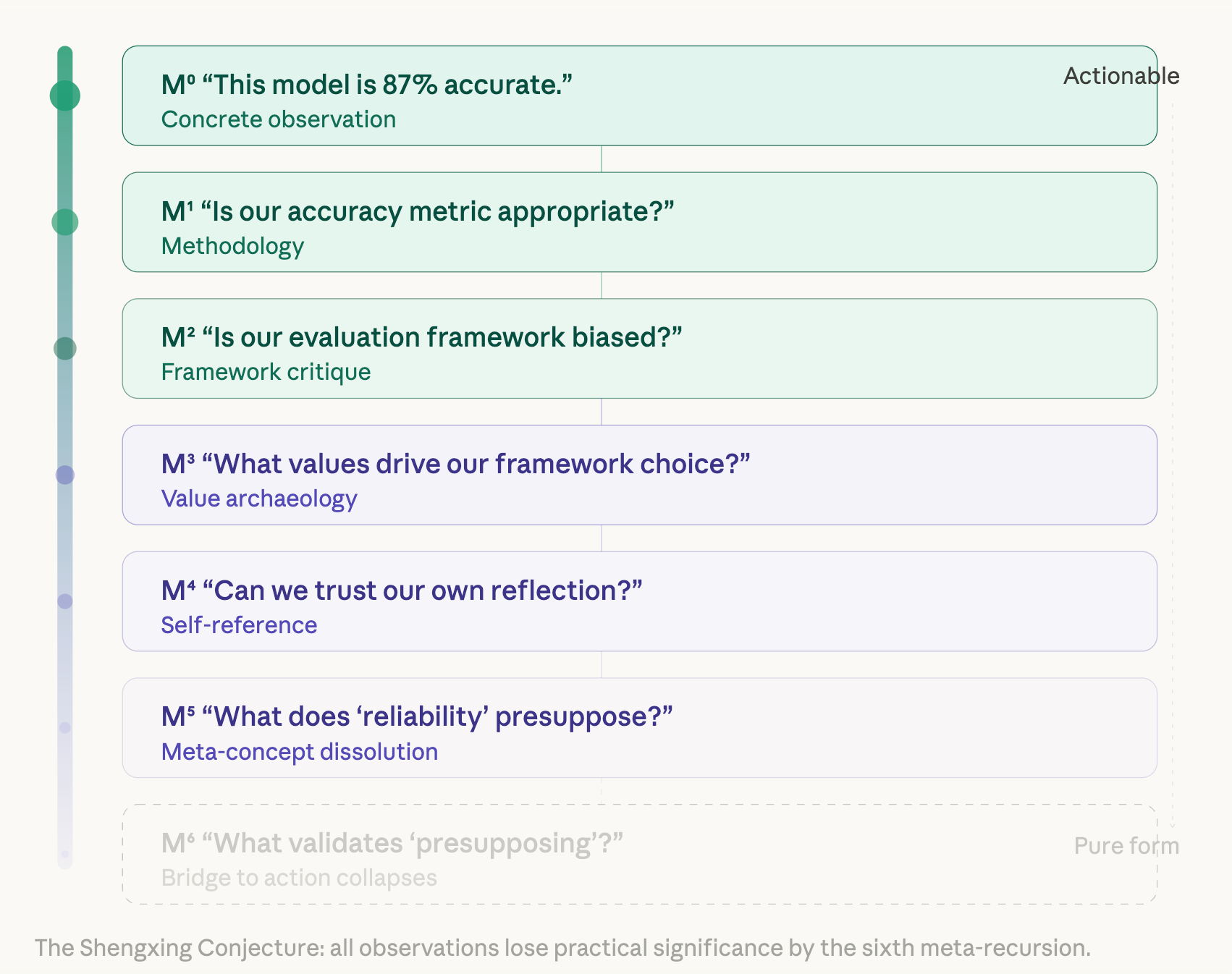
A practical ladder from observation to pure form. The hypothesis is not that abstraction becomes false, but that
it eventually stops carrying usable force back to the original observation.
M0
"This model is 87% accurate."
Concrete observation. Still directly actionable.
M1
"Is our accuracy metric appropriate?"
Methodology. We start interrogating the adequacy of measurement.
M2
"Is our evaluation framework biased?"
Framework critique. The claim now depends on the structure that produced it.
M3
"What values drive our choice of framework?"
Value archaeology. Selection criteria themselves become the object of diagnosis.
M4
"Can we trust our own capacity for reflection?"
Self-reference. The evaluator starts evaluating the conditions of evaluation.
M5
"What does cognitive reliability itself presuppose?"
Meta-concept. Even the vocabulary of reliability begins to dissolve under recursion.
M6
"What validates the operation of presupposing?"
Pure form. The bridge to action appears to collapse.
03 · Why Six?
The number is a conjectural threshold, not a mystical constant.
Why six? One reason for taking the threshold seriously is that many cognitive and systems hierarchies seem to
cluster around five to seven layers: Bateson's learning levels, Dilts' neurological levels, Kohlberg's moral
stages, and even the OSI model in a very different domain. That convergence may reflect a structural constraint in
human cognition.
The claim is not that reality objectively loses meaning at layer six. The weaker and more plausible claim is that
human systems lose the ability to map abstraction back into the original action space somewhere around there. One
might even hear an echo of Miller's 7 plus or minus 2: not as proof, but as resonance.
04 · Two Versions
The conjecture can be stated conservatively or aggressively.
Weak version · cognitive
Human systems may not be able to bring deeper recursion back into the original action space.
For human cognitive systems, meta-recursive results beyond roughly six iterations cannot be effectively mapped
back to the original observation's action space. The limit is epistemic and practical rather than metaphysical.
Strong version · structural
Actionable information content may monotonically decay as recursion deepens.
The stronger claim is that the actionable information content of any meta-recursive sequence decreases with
each step, approaching zero around the sixth iteration. That is a bolder structural thesis, and therefore more
vulnerable to counterexample.
05 · Design Implication
If the conjecture holds, the five-level maturity model is already near the practical ceiling.
A usable model should stop before philosophy fully takes over.
If this conjecture is directionally right, then my five-level metacognitive maturity model sits near the
operational edge. L4 is already touching the self-referential boundary. L5 is marginal. L6 becomes philosophy in
its pure form, interesting perhaps, but no longer reliably capable of changing the original observation.
L0 to L4 can still steer concrete design, governance, or diagnostic choices.
L5 may remain useful only for rare, unusually reflective institutional settings.
L6 marks the point where the recursive engine keeps moving but practical significance drains away.
06 · Invitation
A conjecture is not a theorem. It is an invitation to break it.
I would genuinely like to be proven wrong. If there is a domain where the seventh meta-recursion still carries
practical weight, that domain matters. The conjecture only becomes interesting if someone can identify a living
counterexample where deep recursion still returns to the starting fact with usable force.
This essay is currently published in English only so the wording of the conjecture stays as precise as possible.
Closing
Recursion is not the problem. The problem is when recursion stops paying rent in the world.
That is the wager of this conjecture. Not that abstraction is useless, but that it eventually stops earning its
place as a guide to action. Once the bridge collapses, sophistication remains while practical significance fades.