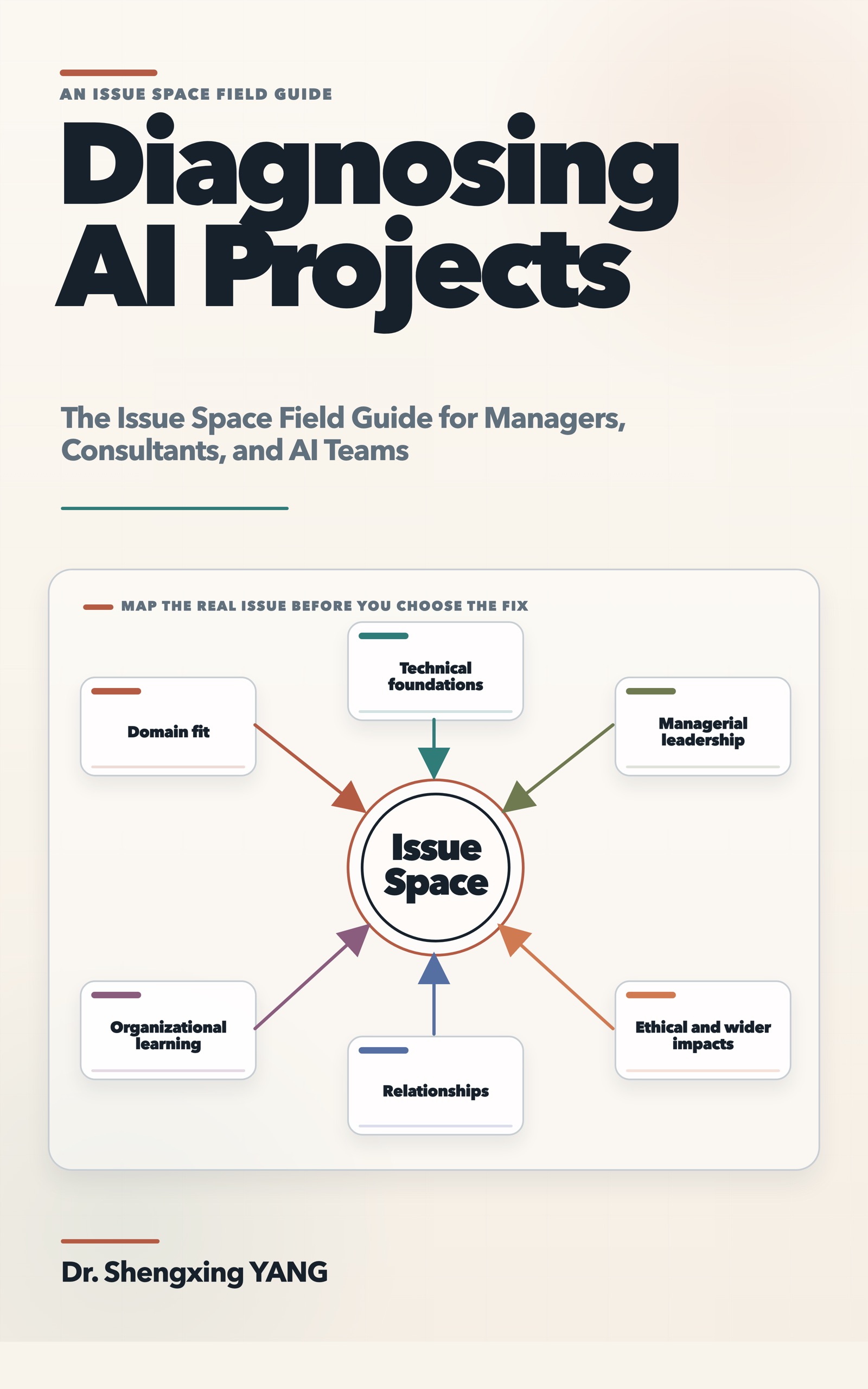
Book-First Route
Start with Diagnosing AI Projects if you want the practical entry point.
The book is the shortest path into the Issue Space method: figures, reading sample, and a direct Amazon link for readers deciding whether to buy.
Bienvenue · Welcome · 欢迎
One path focuses on the thesis. One is an interactive profile. The third opens my new book. The fourth opens a blog about AI, judgment, and workflow.
Profil orienté recrutement en France: stratégie IA, analyse organisationnelle et exécution produit.
Tip / Astuce: you can switch between all four pages anytime from the top navigation.
Doctoral Research Completed, made public-friendly
A public-friendly gateway to the dissertation, with one clear focus: AI preparedness for organizations and society.
Book-First Route
The book is the shortest path into the Issue Space method: figures, reading sample, and a direct Amazon link for readers deciding whether to buy.
Personal Assessment
This is the individual extension of the same logic: a research-backed AI readiness assessment for people, not a project diagnosis for teams.
Direct Contact
Readers, consultants, and teams can use this site to move from diagnosis to conversation: advisory exchange, speaking, workshop ideas, or follow-up questions.
Thesis Brief
Architecting AI Competences Toward 2035: A Mixed-Methods Study on AI Issue Space Mapping and the Articulation of an Organizational Competence Taxonomy.
Supervisor Professor Ahmed Bounfour, Emeritus Professor, Universite Paris-Saclay.
Defense completed (20 Feb. 2026)
Why This Matters
AI changes work, decisions, and public services faster than many institutions can adapt.
Which competences should organizations build now to stay responsible and effective by 2035?
A practical taxonomy linking AI issues to concrete competence choices.
How It Was Studied
01
Systematic review of AI transformation issues in management and policy contexts.
02
Semi-Delphi expert dialogue to test, adjust, and strengthen competence categories.
03
International survey and complementary empirical analysis across institutional settings.
Key Findings
Governance, discretion, ethics, and coordination are as critical as model-building skills.
There is no one-size-fits-all AI skill model; context and institutional role matter.
Platform choices influence what organizations can learn, govern, and scale over time.
Chapter 5 Lens
Micro level
As AI guidance expands, human discretion in professional judgment can narrow, creating tension between efficiency and responsible decision-making.
Meso level
Organizations may become dependent on a few platforms for models, data, and tooling, which can reduce strategic autonomy and bargaining power.
Macro level
The speed of AI deployment can outpace regulation, institutional learning, and social adaptation, amplifying systemic risk.
Issue-Driven Framework
In this thesis, competences are not listed first. They are derived from issues: the Issue Space diagnoses challenge dimensions, and competence categories define organizational responses.
Issue Space (6 dimensions)
AI Competence Categories (6 dimensions)
01
Context fit of AI with sector workflows and knowledge.
01
Industry and task understanding to make AI relevant in context.
02
Data quality, integration, infrastructure, and cybersecurity.
02
Technical and infrastructural foundations to build and run AI.
03
Strategic alignment, culture, resources, trust, and leadership support.
03
Ongoing alignment between AI initiatives, goals, and change capacity.
04
Learning, adaptation, readiness assessment, and resource configuration.
04
Organizational learning, sensemaking, and adaptive decision capability.
05
Human-AI interaction, cross-functional coordination, and stakeholder alignment.
05
Collaboration and coordination among humans, AI systems, and stakeholders.
06
Agency, labor effects, bias, regulation, and societal concerns.
06
Ability to anticipate and handle legal, ethical, and social impacts.
Selected mapping 01 / 06
Issue: Context fit of AI with sector workflows and knowledge. | Competence: Industry and task understanding to make AI relevant in context.
This mapping is a starting structure. In practice, competences overlap and must be bundled dynamically across contexts and transformation stages.
Chapter 7 Implications
As AI scales, preserving meaningful human discretion, workforce sustainability, and trustworthy use becomes a core public concern.
Use the Issue Space as a diagnostic tool, reconfigure competences across AI lifecycle phases, and build special competences to reduce platform lock-in risks.
Combine anticipatory policy tools with curriculum redesign to protect entry-level pathways and strengthen AI literacy, ethics, and collaboration capabilities.
From Thesis to Book
If you are looking specifically for Diagnosing AI Projects, this is the shorter public-facing entry point built around AI project diagnosis, the Issue Space method, and a direct sample PDF.
AI project diagnosis before teams overspend, overhire, or scale the wrong response.
Issue Space: a six-dimension way to test a complaint before locking into one explanation.
Read the sample, review the visuals, and if the diagnosis mirrors your own situation, contact the author directly.
Essay Series
This blog section turns workflow systems into essays, reports, and maps. The current set includes six public pieces: two open-source skill essays, one conjecture on the sixth meta-recursion limit, one interactive governance model on metacognitive maturity, one long-form UiPath strategy report, and one diagnostic map for agentic AI consultants and project leaders.
Map 06 · Agentic AI
An interactive matrix linking Gartner's 2026 agentic AI lens, Issue Space 6D, and the Shengxing Conjecture to surface diagnosis and action at each intersection.
Report 05 · Enterprise Automation
A long-form strategic report on UiPath's financial reset, regulated-industry role, competitive landscape, and why legacy-system execution still matters in the agentic automation transition.
Essay 03 · Meta-Recursion Limit
A conjecture on the practical limit of recursive reflection: by the sixth iteration of asking for a claim's presuppositions, the bridge back to action may have collapsed.
Essay 04 · Reflective Governance
An interactive essay built from the Issue Space line of work: a five-level ladder for asking how far an organization can reflect on the conditions of its own AI judgment.
Essay 01 · Workflow Judgment
A bilingual essay built from token-efficient-subagent-decomposition: why multi-agent enthusiasm often confuses visible activity with real progress.
Essay 02 · Writing Systems
A bilingual essay built from PaperSprint: why academic writing needs structured sprints, not endless AI-assisted drift.
Direct Routes
If you arrived from search rather than from the thesis brief, these are the clearest direct routes for contact, app portfolio context, and the essay pages that most often carry the core argument forward.
A direct contact route with email, LinkedIn, CV access, reading sample links, and assessment QR access.
A standalone portfolio page for seven App Store releases, including MemoK and the rest of the shipped iOS work.
An interactive note on metacognitive maturity in AI governance and the practical limit of recursive reflection.
A focused argument on subagent delegation discipline, coordination cost, and why visible activity can cheapen meaning.
A PaperSprint essay on revision sprints, final responsibility, and why human sign-off remains structurally scarce.
The full series index for essays, reports, and maps on contradiction, workflow, governance, and diagnosis.
About the Author
FAQ
Because AI decisions increasingly affect education, jobs, rights, and access to services.
No. The research shows managerial, legal, and ethical competences are central too.
Yes. It proposes a taxonomy that can guide competence planning and strategic priorities.
Yes. This page can be shared as a post-defense summary. The full thesis text is temporarily unavailable.
Sources
Update Notice
Defense is completed and graduation is confirmed. Public source materials and the full-text package will be uploaded once final publication packaging is ready.
Release timing: To be announced (defense completed on February 20, 2026).
For urgent academic inquiries: shengxing.yang@universite-paris-saclay.fr
Friendly Links