 SaltLessAll apps ↗
No app needed: start with what you ate
Look at the top of the nutrition panel first. US labels give sodium per serving; labels in the EU and UK usually give salt per 100 g, and often per portion too. Per-100 g numbers are good for comparing foods, but they aren’t what you ate. A pack may hold two servings, and you might only eat half of one.
An example: a 120 g pack of crackers lists 800 mg of sodium per 100 g. You eat a quarter of the pack, which is 30 g. On a calculator, 800 × 30 ÷ 100 gives 240 mg of sodium; divide by 400 and you get about 0.6 g of salt. Finish the whole pack and it’s 960 mg of sodium, about 2.4 g of salt. (Made-up numbers, not a real brand.)
If the label is per serving, say 200 mg of sodium in a 25 g serving, two servings are 400 mg of sodium, about 1 g of salt. Half a serving? Multiply by one half. Do the portion first and the unit second, and you’re less likely to slip up.
Drinks and sauces are often listed per 100 ml, so use how many millilitres you had. Don’t swap grams and millilitres unless you know the density. If you’re unsure of the amount, weighing is the safest bet; if you have to guess, remember it’s a guess.
The number to remember: 400
For everyday logging, one rule does it: sodium (mg) ÷ 400 ≈ salt (g). The other way round, salt (g) × 400 ≈ sodium (mg). It works because table salt (sodium chloride) is about 40% sodium by weight. The FDA explains why salt and sodium aren’t the same thing.
That gives you a salt equivalent, not the amount of table salt the maker actually added. Some of the sodium can come from other ingredients, but it’s all already in the sodium figure on the label. So once you’ve converted it, don’t add it again in the same entry.
If you keep your own log, a simple list in Notes works: what you ate, how much, milligrams of sodium. Add it up in one unit each day. Stick to either sodium or salt and you won’t count the same food twice.
Logging every day? SaltLess saves a few steps
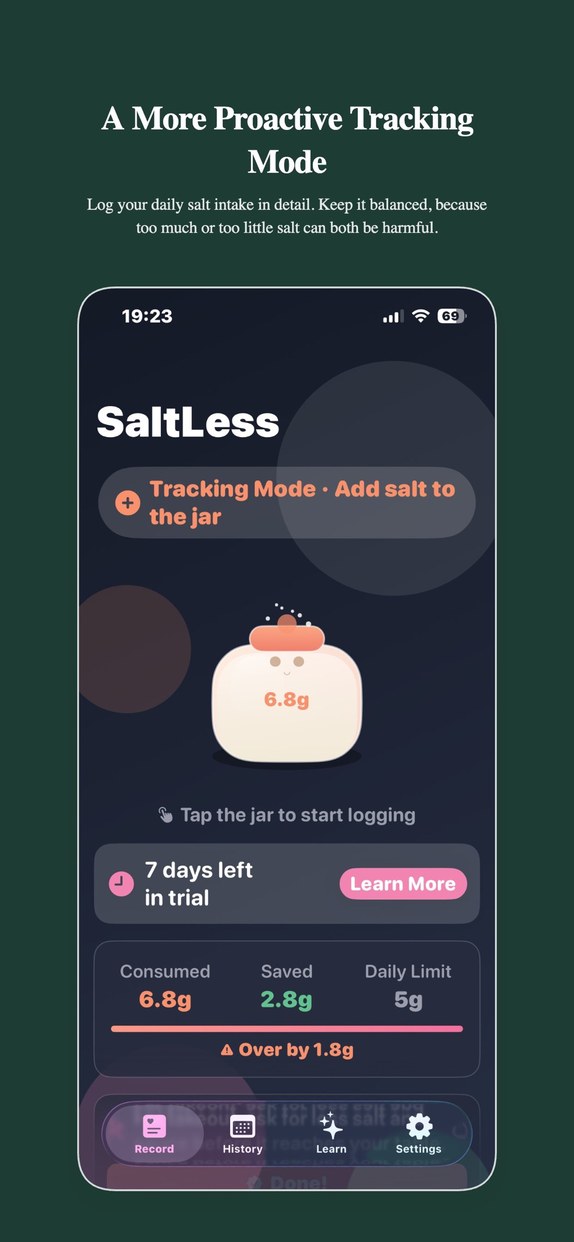
If you plan to log daily, you can enter the amount you actually ate in SaltLess’s Tracking Mode. It takes sodium or salt and converts between the two, and it keeps your history and trends, with daily reminders. No more digging through notes to find what you had yesterday.
Before you save, check three things match: the label’s basis, the amount you ate and the number you typed. Treat a per-100 g figure as the whole pack and the conversion will be precise and still wrong.
SaltLess also has a Zen Mode for salt you chose to leave out, which is not the same as what you ate. Using 1 g less salt in tonight’s cooking is worth noting as a reduction, but it doesn’t tell you how much you had in total, and it shouldn’t be subtracted from your intake log.
SaltLess is a free download with in-app purchases. A 7-day in-app trial starts the first time you open it, separate from any App Store introductory offer; monthly and yearly subscriptions renew automatically. See the App Store for current prices and terms.
When something else makes more sense
For a single bag of snacks, a calculator is all you need.
Eating out with no nutrition information and no idea of the recipe or portion? No tool will make that accurate. Don’t turn a guess into a measurement just to fill in the day.
SaltLess is a personal log. It doesn’t diagnose or give treatment advice, and the examples here aren’t a daily target for you. If your doctor has given you advice, follow it.
Frequently asked questions
The details before you begin
How much salt is 1,000 mg of sodium?
About 2.5 g of salt. First check whether that 1,000 mg is per serving, per pack or per 100 g.
The label says 800 mg of sodium per 100 g. Is that what I ate?
Only if you ate exactly 100 g. If you ate 30 g, multiply by 30 and divide by 100.
The label already shows salt. Should I convert it to sodium?
No need to go back and forth. Pick one unit and keep your totals in it.
Does salt I left out of a recipe count as eating less?
It’s the amount you chose to leave out, not your total for the day. SaltLess keeps the two in separate modes.
Can the app tell how much I really ate today?
No. It relies on what you enter. Missed items, unchecked portions and unknown restaurant recipes won’t become accurate through conversion.
Sources & scope
Written by SaltLess’s developer. Features and pricing checked against the SaltLess page and product data on 4 November 2026. The conversion is an everyday approximation; the examples aren’t personal dietary advice.